A few months back, I started a "links I would send to chanson" series. This would be another link I would have sent to chanson (but I'm posting it here for discussion/reflection). There was another program in the npr series that I will write more about in part 2.
Did a belief in the supernatural (or supernatural consequences) help humans evolve into who we are today?
I thought this was a really interesting program. The question this program (and others in the series) have asked is, what makes us human? What gave us an advantage over other species?
One of the theories is, humans cooperate, human strangers cooperate and no one knows why. As the article says, there's often tension between the interests of the group and the individual.
The article also points out that if in ancient communities, someone stepped out of line (or outside of the boundaries), it made much more sense to say that a person was enforcing "God's law", rather than open the punisher up for vengeance or grudges. An example of this would be that the executioner would wear a mask. Even though many people might know who the executioner was, the person would wear a mask to prevent reprisals.
And the article points out the different criticism of these theories - other theories about why humans cooperate.
This program, The Human Spark on pbs some months ago also talks about the nature of evolution - why humans and chimps are similar but different.
I find the experiments with the very young children compelling. It is amazing to me how early humans learn socialization and about social rules. That even an 18 month old will try to help the experimenter figure things out. Humans like to work together, they like to cooperate; and they also like to make and enforce social rules and norms.

Showing posts with label spirituality. Show all posts
Showing posts with label spirituality. Show all posts
Tuesday, August 31, 2010

Monday, September 14, 2009
Watchmen

A movie that has stuck with me over the months has been "The Watchmen". As someone who has seen quite a few comic book movies over the years (think the X-Men and Spiderman franchises, even Sin City) - I wasn't really prepared for this movie.
Because, instead of following the typical hero cycle - a person is left to wonder who the heroes really are. The main characters do not appear to be - and rarely seem to help people.
And that at times, people tend to do more harm by interfering (causing a premature end to the Viet Nam conflict). Would we be where we are if that had happened?
The plot questions a person's goals - and whether or not it is sometimes better to fail than get what you want (world peace, for example).
(Just as an aside for my readers/friends who are disturbed by such things, there is definitely explicit violence and sex, including an attempted rape. Also, if you weren't aware, one of the main characters is naked for a third of the film. Most of the critics seemed to focus on the male character's nudity - instead of the film itself, which was unfortunate. I wonder what's so threatening about a male nude? There are plenty of female nudes in film).
All in all - I'm glad I saw it, and that I saw it in the theater.
PS. To my mind, it probably didn't hurt that they used a Leonard Cohen song in the soundtrack. Although that song (Hallelujah) is almost becoming a cliche - I'm not sure that was where it originally meant to be.
Friday, April 17, 2009
Greater than myself
As always, this is all just my personal opinion and should be taken as such. I respect that many disagree with me.
As a society, it seems like there is so much focus on a particular demographic (14 - 22 year olds) that I believe we forget that there is a lot that we don't know. And sometimes, it's not the 14 - 20 year olds who are on the cutting edge of this front. It's those who have paid their dues, who have spent lifetimes experiencing, living, studying. (As an aside, I'm not suggesting that older is always wiser).
There is so much that is unknown (period). And there are so many different types of unknowns.
Personally, I can certainly explain a great deal about Russian history during a particular period of time - but would stare at you blankly when asked about quantum physics or advanced calculus.
Things would be quite different if we knew all the answers. I certainly don't have them. I don't know why sh*t happens. I don't know why good stuff happens either. (If I did, I certainly wouldn't be sitting around blogging about it!)
Of course, lots of religions (and other things) have evolved to help explain the unexplainable.
I just find the concept of something greater than myself attractive. That thing could be nature, evolution, love, time, physics, a higher power and/or God (whatever you may call God).
Simply the idea that I don't have all the answers - and there is no way, in my human lifetime, I could ever find all the answers.
Not even that there is a design or reason for everything. But that at this given moment, I can't comprehend it all. Sometimes I may just need to talk with friends or loved ones. Sometimes I can find insight from reading what others have written in the past.
The important concept (for me) is, I'm human. I make mistakes. I have insights and faults. I allow others the same freedom and compassion.
Sometimes it just seems like our society or generation is so me/self focused - the idea that any of us could really "get it" at 16 is hard to fathom. There are things that can be understood, but there's a lot that cannot be easily understood as well.
Life is not simple.
The older I get, the more I realize how much I don't know. How life is not black and white (cannot be reduced to simple maxims or theories). I suppose I thought that I would have a better understanding as I got older, and I just don't seem to be any closer to explaining it all.
I'm not suggesting that anyone has been arguing that they know it all or that they have all the answers.
Just that it takes humility to admit I have limits (just like everyone).
If nothing else, I hope I can share that with my kids - the sense of compassion for others and a sense of awe that life can bring.
As a society, it seems like there is so much focus on a particular demographic (14 - 22 year olds) that I believe we forget that there is a lot that we don't know. And sometimes, it's not the 14 - 20 year olds who are on the cutting edge of this front. It's those who have paid their dues, who have spent lifetimes experiencing, living, studying. (As an aside, I'm not suggesting that older is always wiser).
There is so much that is unknown (period). And there are so many different types of unknowns.
Personally, I can certainly explain a great deal about Russian history during a particular period of time - but would stare at you blankly when asked about quantum physics or advanced calculus.
Things would be quite different if we knew all the answers. I certainly don't have them. I don't know why sh*t happens. I don't know why good stuff happens either. (If I did, I certainly wouldn't be sitting around blogging about it!)
Of course, lots of religions (and other things) have evolved to help explain the unexplainable.
I just find the concept of something greater than myself attractive. That thing could be nature, evolution, love, time, physics, a higher power and/or God (whatever you may call God).
Simply the idea that I don't have all the answers - and there is no way, in my human lifetime, I could ever find all the answers.
Not even that there is a design or reason for everything. But that at this given moment, I can't comprehend it all. Sometimes I may just need to talk with friends or loved ones. Sometimes I can find insight from reading what others have written in the past.
The important concept (for me) is, I'm human. I make mistakes. I have insights and faults. I allow others the same freedom and compassion.
Sometimes it just seems like our society or generation is so me/self focused - the idea that any of us could really "get it" at 16 is hard to fathom. There are things that can be understood, but there's a lot that cannot be easily understood as well.
Life is not simple.
The older I get, the more I realize how much I don't know. How life is not black and white (cannot be reduced to simple maxims or theories). I suppose I thought that I would have a better understanding as I got older, and I just don't seem to be any closer to explaining it all.
I'm not suggesting that anyone has been arguing that they know it all or that they have all the answers.
Just that it takes humility to admit I have limits (just like everyone).
If nothing else, I hope I can share that with my kids - the sense of compassion for others and a sense of awe that life can bring.
Tuesday, April 29, 2008
Books I've read recently
I've actually had some time to read recently - two for book club, two on my own.
The Memory Keeper's Daughter by Kim Edwards

This book had a fascinating premise. The basic plot involves a doctor in the 60s who delivers his own twins in a snowstorm. His wife is in a drugged haze and only the doctor's closest nurse is at the delivery. When he realizes that his daughter has Down Syndrome, he decides to send her to an institution. He also lies to his wife, and tells her their daughter died. Their son survives. Disgusted by the nature of the institution, the nurse chooses to raise the daughter as her own. The book follows the lives of the families, the basis behind the father's decision and lies.
I will say, the characterizations were sometimes a bit stretched. Some of the events seemed improbable. I will admit to being a literary snob - expecting unique and full fleshed out characters with every novel. To my mind, one scene was very contrived, as if "they all woke up and it was a dream". It seemed like an obvious plot device to move the book along. I won't mention what it was, but if you read the book, it's not hard to determine.
What I did appreciate, however, was the notion of how damaging some family secrets can be. Back in the day, families kept silent about many things. Adoption, alcoholism, mental illness, mental disability, ancestry, etc. Sick as our secrets definitely applies here. And in the book, it's obvious that this secret impacted each of the main characters lives. I'd like to think that we are more open today, that we are more willing to face these issues and the supposed embarrassment they might cause.
I will say, in terms of secrets, I do think there are some things better left unsaid. Obviously, in terms of this blog, I don't often take that advice. But as a parent, and a friend, it's hard to know where that line is. But in each decision, a person has to weigh the costs and benefits. And most certainly, with the above list of adoption, mental illness, physical illnesses, death, etc. - I believe fully that a family should be as open as possible.
Which leads me to the second book I've read:
Secret Girl by Molly Bruce Jacobs

In the not so distant past, it was common to institutionalize the mentally disabled. Even today, some Americans find out that they had siblings, family members they never knew they had who had been institutionalized. This was the case for Molly Bruce Jacobs.
Her sister was institutionalized after birth. The author didn't know of her existence until she was thirteen, and didn't visit her until she was in her 30s. The memoir follows her life, as the author struggles to make sense of this impossible choice. She works to develop a relationship with her sister and understand this secret's impact on her life and her alcoholism.
It is an unbelievably sad and honest memoir. It tells how an adult understands and accepts their parents' actions and accepts and forgives their own actions and motivations. Molly wasn't defending her parents' actions, but by writing the memoir and developing a relationship with her sister - she was trying to make things right. As right as she could make them. Just like any of us, knowing we can't make up for the past, but trying to do the best we can with what we have.
On from family secrets/dysfunction:
Night Watch by Sergei Lukyanenko
wikipedia entry about the novel
This is much lighter than the other two books. It's sci-fi/fantasy - good guys vs. vampires, light vs. dark. There is definitely a tradition of Bulgakov here, I don't get all the references but I'm pretty certain they are there. Like the best sci-fi books, there isn't a clear line between good and evil. Everyone is just doing their best, what they think is the best.
While there are some great female characters in this book (like Tiger Cub and Olga), it doesn't pass the two females having a conversation on screen test. At least not in this first book. There is, of course, one scene where Anton switches bodies with Olga - and has a conversation with his love interest, but that doesn't count (to my mind). That scenario is actually very Russian - from my experiences there. Many of my American professors would say that Russian culture (at least in the mid-90s) was as if the sexual revolution never happened here. It still may be true. At least, women are required to wear makeup, care about their appearance - otherwise they might be lesbians.
Okay, perhaps that isn't fair with the novel, but there is definitely a Russian cultural tradition there. And, with all the comments about switching bodies and Anton struggling with high heels and makeup - and other restaurant goers saying that Anton looked butch - it's not a stretch to my mind. I may be mistaken - but that was my impression. The women in the novel (and movies) do have a central role, but it was some of those stereotypes that really bothered me.
So aside from American cultural issues, it was a fascinating insight into current Russian culture (despite being about vampires). The reader knows that Anton's side, the light, is fighting a losing battle, but you can't help but root for them.
Last but not least is:
The Painted Drum by Louise Erdrich

I've always like Louise Erdrich's work. She has an amazing grasp on language. She also has stunning insight into humans and their relationships. This was one of the books we discussed at book club, and one of the participants praised the use of native american culture and lore. It is, sadly, a perspective and story that is not often told. Just as with the first two books, some parts were particularly sad. One or two of the characters/sub plots did seem out of place, but all in all, an interesting read.
The issues she discusses of repatriation are incredibly important and relevant. It is difficult to decide which community an object belongs to, particularly a sacred object. In the novel, the drum has an intensely spiritual connection - and it restores community (either magically or coincidentally, depending on your perspective).
I think the nature of spiritual objects, respect, scientific study is one I will save for another blog post. But I believe these issues are very important. For many of these native cultures, their objects and culture were stolen. And genocide was committed against some of the native american communities by the United States government. There's no other way to view the small pox laced blankets or the trail of tears.
I found this article on the Smithsonian website when I was researching this topic. The author clearly understands how controversial this topic can be. From what she writes, I can also see the museum and learning perspective. That there may be some history that can be gleaned from specific objects and processes. But only when all parties agree to allow the research and respect is the foundation of the research.
The Memory Keeper's Daughter by Kim Edwards

This book had a fascinating premise. The basic plot involves a doctor in the 60s who delivers his own twins in a snowstorm. His wife is in a drugged haze and only the doctor's closest nurse is at the delivery. When he realizes that his daughter has Down Syndrome, he decides to send her to an institution. He also lies to his wife, and tells her their daughter died. Their son survives. Disgusted by the nature of the institution, the nurse chooses to raise the daughter as her own. The book follows the lives of the families, the basis behind the father's decision and lies.
I will say, the characterizations were sometimes a bit stretched. Some of the events seemed improbable. I will admit to being a literary snob - expecting unique and full fleshed out characters with every novel. To my mind, one scene was very contrived, as if "they all woke up and it was a dream". It seemed like an obvious plot device to move the book along. I won't mention what it was, but if you read the book, it's not hard to determine.
What I did appreciate, however, was the notion of how damaging some family secrets can be. Back in the day, families kept silent about many things. Adoption, alcoholism, mental illness, mental disability, ancestry, etc. Sick as our secrets definitely applies here. And in the book, it's obvious that this secret impacted each of the main characters lives. I'd like to think that we are more open today, that we are more willing to face these issues and the supposed embarrassment they might cause.
I will say, in terms of secrets, I do think there are some things better left unsaid. Obviously, in terms of this blog, I don't often take that advice. But as a parent, and a friend, it's hard to know where that line is. But in each decision, a person has to weigh the costs and benefits. And most certainly, with the above list of adoption, mental illness, physical illnesses, death, etc. - I believe fully that a family should be as open as possible.
Which leads me to the second book I've read:
Secret Girl by Molly Bruce Jacobs

In the not so distant past, it was common to institutionalize the mentally disabled. Even today, some Americans find out that they had siblings, family members they never knew they had who had been institutionalized. This was the case for Molly Bruce Jacobs.
Her sister was institutionalized after birth. The author didn't know of her existence until she was thirteen, and didn't visit her until she was in her 30s. The memoir follows her life, as the author struggles to make sense of this impossible choice. She works to develop a relationship with her sister and understand this secret's impact on her life and her alcoholism.
It is an unbelievably sad and honest memoir. It tells how an adult understands and accepts their parents' actions and accepts and forgives their own actions and motivations. Molly wasn't defending her parents' actions, but by writing the memoir and developing a relationship with her sister - she was trying to make things right. As right as she could make them. Just like any of us, knowing we can't make up for the past, but trying to do the best we can with what we have.
On from family secrets/dysfunction:
Night Watch by Sergei Lukyanenko
wikipedia entry about the novel
This is much lighter than the other two books. It's sci-fi/fantasy - good guys vs. vampires, light vs. dark. There is definitely a tradition of Bulgakov here, I don't get all the references but I'm pretty certain they are there. Like the best sci-fi books, there isn't a clear line between good and evil. Everyone is just doing their best, what they think is the best.
While there are some great female characters in this book (like Tiger Cub and Olga), it doesn't pass the two females having a conversation on screen test. At least not in this first book. There is, of course, one scene where Anton switches bodies with Olga - and has a conversation with his love interest, but that doesn't count (to my mind). That scenario is actually very Russian - from my experiences there. Many of my American professors would say that Russian culture (at least in the mid-90s) was as if the sexual revolution never happened here. It still may be true. At least, women are required to wear makeup, care about their appearance - otherwise they might be lesbians.
Okay, perhaps that isn't fair with the novel, but there is definitely a Russian cultural tradition there. And, with all the comments about switching bodies and Anton struggling with high heels and makeup - and other restaurant goers saying that Anton looked butch - it's not a stretch to my mind. I may be mistaken - but that was my impression. The women in the novel (and movies) do have a central role, but it was some of those stereotypes that really bothered me.
So aside from American cultural issues, it was a fascinating insight into current Russian culture (despite being about vampires). The reader knows that Anton's side, the light, is fighting a losing battle, but you can't help but root for them.
Last but not least is:
The Painted Drum by Louise Erdrich

I've always like Louise Erdrich's work. She has an amazing grasp on language. She also has stunning insight into humans and their relationships. This was one of the books we discussed at book club, and one of the participants praised the use of native american culture and lore. It is, sadly, a perspective and story that is not often told. Just as with the first two books, some parts were particularly sad. One or two of the characters/sub plots did seem out of place, but all in all, an interesting read.
The issues she discusses of repatriation are incredibly important and relevant. It is difficult to decide which community an object belongs to, particularly a sacred object. In the novel, the drum has an intensely spiritual connection - and it restores community (either magically or coincidentally, depending on your perspective).
I think the nature of spiritual objects, respect, scientific study is one I will save for another blog post. But I believe these issues are very important. For many of these native cultures, their objects and culture were stolen. And genocide was committed against some of the native american communities by the United States government. There's no other way to view the small pox laced blankets or the trail of tears.
I found this article on the Smithsonian website when I was researching this topic. The author clearly understands how controversial this topic can be. From what she writes, I can also see the museum and learning perspective. That there may be some history that can be gleaned from specific objects and processes. But only when all parties agree to allow the research and respect is the foundation of the research.
Saturday, January 5, 2008
Man's Search for Meaning
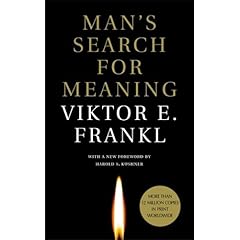
This is a phenomenal story of courage despite all odds. Frankl lost his parents, brother and pregnant wife in concentration camps. Yet he survived and is able to write a stunning defense of the dignity of human beings.
He mentions that the freedom that no one can take away from us - the ability to choose how we will respond and react to a situation. I read this work first in high school. I find even ten years later his concepts of dignity, freedom and kindness resound with me.
He also denounces the idea of collective guilt. At one point, he defends his use of German. One person questioned him - how can you write in German, the language of Hitler? He asked her if she has knives in her kitchen. When she admitted she did, he asked "How can you still use knives after so many killers have used them to stab and murder their victims?" (p. 150)
While there is a great deal of spirituality in this book, I did not feel that one has to be a religious or spiritual person to appreciate it. I didn't feel that a person had to believe in a wrathful God to understand suffering - or to simply attribute all suffering to "God's Will".
Frankl dives head first into these concepts - implying that suffering is part of the human condition - and that we have a choice for how we decide to respond to it. One of the more famous quotes from the book is:
"Our generation is realistic, for we have come to know man as he really is. After all, man is that being who invented the gas chambers of Auschwitz; however he is also that being who entered those gas chambers upright, with the Lord's Prayer or the Shema Yisrael on his lips" (p. 134)
My only disagreement is with the concept of euthanasia. Frankl argues passionately against that - saying that if there is no meaning in suffering, that euthanasia should be allowed. I believe that through some of the medical advances that have been made, that this is an important decision for a person, their family and loved ones. I think a person can believe in life with dignity and disagree with this point - that sometimes it is acceptable to let a person go.
Subscribe to:
Posts (Atom)