I've become more aware of female characters in fiction - particularly classic fiction. I re-read The Good Earth by Pearl Buck for book club. The novel is a classic - Pearl Buck won the Pulitzer for it. The descriptions are vivid; and the characters, despite differences in culture, are timeless. Yet I was struck by the novel's misogyny and sexism. Of course it's historically accurate. A woman gives birth to a daughter and exclaims " another slave".
The main character's first wife, O-lan, is the patriarchal female ideal. I would give this book to someone to explain this ideal that women are fighting - consciously or unconsciously. Sold into actual slavery by his parents, she is sold from the family she serves to her husband.
Without being asked, she takes over care of the home, cooking for the main character's (Wang's) father. She asks for nothing for herself. When she gives birth, she goes alone into her room. She doesn't make a sound - after giving birth she goes out into the fields.
In the book club group, we agree that she is the reason for the family's success. But she remains unrecognized and unacknowledged. The husband takes her only treasured possession, twp pearls, to bring a second wife into their home.
She is never supposed to complain, show anger towards her husband. She is the ideal long-suffering, patient, devoted wife and mother. In the end during her terminal illness, she refuses to die until her daughter in law moves into the home to care for everyone.
The mother/martyr archetype is still the ideal, whether or not people want to admit it. A woman (particularly a mother) should never want something for herself. She should never admit she is sick, never directly ask for what she wants or needs. She should never demand recognition of what she does. This is the stereotype my grandmother and mother have had to fight against - and yet I wonder how they see themselves. Would they (would I) have the self-esteem to refuse to give their prized possession to their husbands? And would they withstand the criticism from their husbands (and society) for being selfish or narcissistic? A good measure is whether or not men would ever be asked to make the same sacrifices.
There is a great deal of narcissism and selfishness in modern American culture. But let's be clear. Women getting an education, waiting for marriage and motherhood, are not being selfish. Families limiting their family size to those they can financially, physically and emotionally care for - not selfish. Women having an identity outside of wife and mother - not selfish.
I'm certainly glad that times are changing. That this explicit misogyny is no longer the status quo for the majority of American women. I'm grateful for all the people (women and men) who fought to get rid of this second class status for half of the population.

Showing posts with label book club. Show all posts
Showing posts with label book club. Show all posts
Friday, August 31, 2012

Saturday, May 14, 2011
The Help
 This is a link to a great discussion of "The Help" from the program "Tell Me More" on npr. It gives the perspective of different people on this best selling book. To summarize the discussion, one of the maids in the book bears a striking resemblance to a maid in Ms. Stockett's own family. There is also a discussion of the accents in the book, the white characters do not have disernable accents, but the characters of color do.
 I think that the npr discussion brings up many good points. The reaction to the novel tends to be different from people of different races. And I think the notion of going to a job versus actually caring about where you work and the people you work for is intriguing. This is a sensitive topic. An employee may want to give the impression that "they care", but in the end, if the boss is asking, is the question invalid? Will employees really tell the truth, particularly if their job is on the line. My take is they will not. But that's not to say that there aren't amazing people who love their jobs, and love what they do. I simply don't think that assumption can be made for everyone.
I agree with the discussion that an author does have a responsibility to change identifying characteristics about their characters. However, the line between fiction and non fiction is blurred. I have seen books considered "non fiction" memoirs that seemed like fiction and fiction that made a person question if the stories were real or not. Chanson wrote a great post about authors and how auto-biographical their fiction can be here.
Overall, as this book has become wildly popular with book clubs, I was prepared not to like Stockett's book. But it was engaging and the story well written. The women "told truth to power" (in the civil rights South) , and any stories like that (fiction or non-fiction) I support.
Sunday, November 21, 2010
Eat, Pray, Love
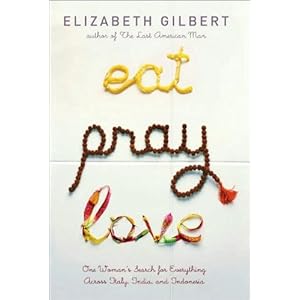
Despite my joining of certain social networking sites, I have a love/hate relationship with certain cultural trends. If it's incredibly popular, I'm generally suspicious.
They selected this book for my book club before much information was known about the movie. I was understandably skeptical.
I found I liked this book much more than I thought I would. I agreed with Julie Ann's comments about personal growth here.
Two things resonated with me. The first was what she said about not wanting to be married any longer - about not being happy. Many people have criticized the book, they said that the author was selfish and whiny.
Honestly, I think it's pretty remarkable to admit that a person is not happy, and wants to change. Not everyone is willing to do that. Not everyone is willing to acknowledge they're in pain, and to take steps to change that, whatever the cost.
I don't think that's whiny, I think that's being realistic. Not that happiness is the only answer and motivation. But I believe each person has only one life, and it is much to short to live in misery. Is it really necessary to get a book advance and travel around the world? Probably not. But admitting that a person isn't (you aren't) happy, and taking steps to change is a good thing, to my mind. If there are things that can change, that you can change - I think it's a good thing to work towards that.
The second thing I admired was that she didn't give all the reasons for her divorce. I thought that was pretty remarkable as well. Often people will go through all the reasons for a relationship ending, detailed reasons. Sometimes it's to convince other people that their decisions were justified. In the end, does it really matter? In the end, we really only need to know that a relationship was not healthy, and not working.
And in the end, I appreciated what she said about not really thinking about her relationship before she entered into her marriage. While she loved her ex-husband, she wasn't really thinking of goals, ways for each person to support themselves. What each person brought to the marriage. It's decidedly unromantic. But honestly, I think that message needs to be sent more. Love is great, but life isn't a hollywood romance. It's just not. It takes a lot of work to support and understand yourself, not to mention another person.
PS. So I recommend this book to just about anyone. For my atheist, agnostic and non- religious friends, there is a lot of prayer in the prayer section. So that's a caution or warning. But if you're able to look past that, there may be some parts of the book that a person could find useful. The idea of spending time meditating, in India, was attractive to me. I'm not sure why, it's just always been attractive. But that's just me personally, and may not be attractive to other people.Granted, it may also be the traveling aspect - as I have very little desire to spend three months meditating here in the midwest. So take that as you will.
Saturday, May 8, 2010
Ad hominem
I recently read part of "Silent Spring" by Rachel Carson, for book club. Written back in the early 1960s, her book began an environmental awareness movement. People began to care more about chemicals used to kill bugs, and those used in farming. I don't want to argue her point, because it is worth reading for yourself.
Here is a link to a pbs program about the book and her journey.
What shocked me, personally, were the attacks on her person about the book. She was called a "tree hugger", which was an insult at the time.
And finally, someone said that she couldn't understand what it meant to be caring and nurturing because she wasn't a mother. This insult still makes me see red just thinking about it.
And usually, when someone attacks the person instead of the argument (ad hominem) it's because they can't refute the argument. They are arguing from a position of weakness. The chemical companies couldn't prove that DDT was actually helping birds and their eggs. So they criticized Rachel Carson because she wasn't a mother, and therefore not capable of making scientific observations about the world we live in, or questioning the prevailing wisdom.
On this mother's day, I would like to point out that there are many ways for everyone to be conscious of their lives and their impact. There are many ways to help the next generations, to be caring and responsive.
Here is a link to a pbs program about the book and her journey.
What shocked me, personally, were the attacks on her person about the book. She was called a "tree hugger", which was an insult at the time.
And finally, someone said that she couldn't understand what it meant to be caring and nurturing because she wasn't a mother. This insult still makes me see red just thinking about it.
And usually, when someone attacks the person instead of the argument (ad hominem) it's because they can't refute the argument. They are arguing from a position of weakness. The chemical companies couldn't prove that DDT was actually helping birds and their eggs. So they criticized Rachel Carson because she wasn't a mother, and therefore not capable of making scientific observations about the world we live in, or questioning the prevailing wisdom.
On this mother's day, I would like to point out that there are many ways for everyone to be conscious of their lives and their impact. There are many ways to help the next generations, to be caring and responsive.
Sunday, April 25, 2010
Priorities
Due to budget cuts, they will probably be closing the library closest to our home, and the one where I attend book club. I will admit, I have personal reasons for disliking the proposal. We go to story time at the library closest to our home almost every week. I've attended book club for at least three years. There are other libraries and my kids will be going to kindergarten soon.
Public libraries are important institutions. Before there was the internet, libraries were the best reliable source of information. My library has the highest circulation in the area - and there are always people on the various pc's. I always see people meeting in the meeting rooms, learning to read, learning new languages. It is a community center.
I trust I don't need to break out quotes from founding fathers about the importance of libraries, books and the free flow of information.
I support my local library in re-evaluating their priorities. I firmly believe in living within your means.
But my city also contracts with some local sports teams. It's not even a question if the sports teams throw their weight around, asking for millions more. They get what they ask for. Or for a new, state of the art stadium. They have a blank check to get anything their hearts' desire.
I am a fan of some of the local sports teams, and it's true that they are good for some businesses. But it is so difficult for me to read about teachers being laid off and libraries being closed while sports teams are getting bailouts.
I question what our priorities are. In twenty years, after an extensive investment in a local sports team, what do we have? Perhaps some national championships - lots of people who've been employed and those who have attended great games.
With libraries and schools, we can have a more educated populace; we support tools for life-long learning.
I don't understand why libraries and schools always seem to come up short when the chips are down. They don't have trophies or rings. But we have people who are better equipped to live their lives.
We can't preach self- reliance to communities and then take away the tools they have to become better people and more educated citizens.
Public libraries are important institutions. Before there was the internet, libraries were the best reliable source of information. My library has the highest circulation in the area - and there are always people on the various pc's. I always see people meeting in the meeting rooms, learning to read, learning new languages. It is a community center.
I trust I don't need to break out quotes from founding fathers about the importance of libraries, books and the free flow of information.
I support my local library in re-evaluating their priorities. I firmly believe in living within your means.
But my city also contracts with some local sports teams. It's not even a question if the sports teams throw their weight around, asking for millions more. They get what they ask for. Or for a new, state of the art stadium. They have a blank check to get anything their hearts' desire.
I am a fan of some of the local sports teams, and it's true that they are good for some businesses. But it is so difficult for me to read about teachers being laid off and libraries being closed while sports teams are getting bailouts.
I question what our priorities are. In twenty years, after an extensive investment in a local sports team, what do we have? Perhaps some national championships - lots of people who've been employed and those who have attended great games.
With libraries and schools, we can have a more educated populace; we support tools for life-long learning.
I don't understand why libraries and schools always seem to come up short when the chips are down. They don't have trophies or rings. But we have people who are better equipped to live their lives.
We can't preach self- reliance to communities and then take away the tools they have to become better people and more educated citizens.
Monday, December 7, 2009

My book club recently read A Thousand Splendid Suns, by Khaled Hosseini. Set in war torn Afganistan, I found it was an especially sad novel. I think it was easier for me, knowing when I started the novel that it was going to be sad and heart-wrenching.
Throughout the novel, I kept thinking "Can it get any worse for the two main female characters?" And, yes, it could. Life got worse particularly as the Taliban came into power. At one point, the two lead characters, Mariam and Laila, tried to escape their abusive husband. But they couldn't leave Afganistan, as two women, because there wasn't a man with them. They were returned by the Taliban to the husband, who almost killed both of them (including the young daughter) for trying to leave.
The book was so hopeless, it almost seemed like a propaganda piece. But it's not as if the reports of the life of women under the regime of the Taliban were untrue - women unable to find a hospital to give birth in - giving birth under squalid and inhumane circumstances. The thought of the people of Afganistan wanting to go back to that situation gives me pause.
I, for one, certainly do not believe the U.S. needs to be the world's police force, or needs to rescue people in these countries.
With that said, it seems deplorable that anyone should have to live in such conditions (as described in this novel). And I have to agree that if we (as a nation) create a mess, we should help clean it up - to make things right where possible, within reason. It is, of course, very complicated and complex. I know that many of my readers may disagree with me, and I respect that we disagree on this issue (sending more troops to Afganistan, or being there in the first place). I'm not even sure that sending additional troops is the "right" solution.
We read a lot of books of people and families without hope in my book club. Some set in the U.S., some set in other countries (surprisingly or not, the description of poverty and hunger remains very similar). In all the novels and memoirs, the common thread of hope was education.
In each work, the main character(s) had one (or more) teachers who took an interest. The teachers (or a muslim cleric in the case of A Thousand Splendid Suns) inspired them to love learning, and to escape their circumstances. In each case, the teachers gave the students hope.
I know it's a few weeks after Thanksgiving, and most people have moved on from their lists of gratitude. But I, personally, am grateful for teachers and educators. Those who inspire a love of learning, or simply give hope where there was none.
Friday, October 30, 2009
Grocery Store Eggs vs. Locally produced Eggs
I read The Omnivore's Dilemma last year for book club. It was a great book and thought-provoking. I think it is important to think about where we get our food, and the impact that our food has on the environment.
Our local farmer's market sells eggs. Typically, the eggs sell out before we get there (10:30 in the morning or so).
One of the assertions in the book was that the quality of the eggs raised at a local farm might be different. They would have a darker yellow yolk and taste differently. There was a particular farm that Pollan visited that raised/sold these types of eggs.
I haven't tried a taste test yet between the two versions: the eggs I bought in the grocery store and the eggs I bought at the farmer's market.
For me, I perceive that the eggs from the farmer's market (with their brown eggshells) taste better. When I use the eggs in food that I prepare, I feel it tastes better. But is that my perception? Would I be able to tell the difference if I didn't know which egg was which?

I don't have a better photo than this one. The egg on the left is from the locally owned free range farm. The egg on the right was bought from the grocery store - presumably some form of caged chicken egg producing operation. The color of the yolk (again, it's not a great photo) is almost identical. Also, the yolk on the right seems to be a bit larger (I didn't actually measure the diameter).
I may try the blind taste test, I might not. I was just interested in trying this experiment. After reading Pollan's book, I was assuming that the difference would be obvious in almost all eggs. It's more nuanced than that.
I will still buy eggs from the farmer's market - I am still conscious of the food I eat and prepare and where it comes from. This post isn't meant to change that. I
t does reinforce my need to continue to investigate and be skeptical of what I read. To research for myself - from all different types of sources. I don't think anyone in the local food movement has suggested otherwise. I encourage my readers to research these types of things for themselves as well. I believe blindly accepting any point of view, however logical or valid the point of view may be - is not always the best way to go.
Our local farmer's market sells eggs. Typically, the eggs sell out before we get there (10:30 in the morning or so).
One of the assertions in the book was that the quality of the eggs raised at a local farm might be different. They would have a darker yellow yolk and taste differently. There was a particular farm that Pollan visited that raised/sold these types of eggs.
I haven't tried a taste test yet between the two versions: the eggs I bought in the grocery store and the eggs I bought at the farmer's market.
For me, I perceive that the eggs from the farmer's market (with their brown eggshells) taste better. When I use the eggs in food that I prepare, I feel it tastes better. But is that my perception? Would I be able to tell the difference if I didn't know which egg was which?

I may try the blind taste test, I might not. I was just interested in trying this experiment. After reading Pollan's book, I was assuming that the difference would be obvious in almost all eggs. It's more nuanced than that.
I will still buy eggs from the farmer's market - I am still conscious of the food I eat and prepare and where it comes from. This post isn't meant to change that. I
t does reinforce my need to continue to investigate and be skeptical of what I read. To research for myself - from all different types of sources. I don't think anyone in the local food movement has suggested otherwise. I encourage my readers to research these types of things for themselves as well. I believe blindly accepting any point of view, however logical or valid the point of view may be - is not always the best way to go.
Thursday, October 1, 2009
Under the Banner
I sometimes guest post for the main street plaza blog.
I wrote a post here about my book club and its discussion of the book. Check it out!
PS. To my non mormon friends who read this blog, although Under the Banner of Heaven: A Story of Violent Faith was disturbing on many levels, I recommend it. Actually, I recommend it for just about anyone. I think the issues it brings up about faith, religion and fundamentalism are important and worthy of discussion.
I wrote a post here about my book club and its discussion of the book. Check it out!
PS. To my non mormon friends who read this blog, although Under the Banner of Heaven: A Story of Violent Faith was disturbing on many levels, I recommend it. Actually, I recommend it for just about anyone. I think the issues it brings up about faith, religion and fundamentalism are important and worthy of discussion.
Friday, June 5, 2009
Guns, Germs and Steel
I don't know if I've mentioned recently how much I enjoy my book club. I'm still participating, and we are still reading fabulous books. This is one of the books I suggested last year.

I recommend this book to just about anyone (including former mormons in particular). It is long and at times, difficult to wade through (wordy). This is exactly the type of book I would have been assigned to read in a college history course. I don't think that should discourage anyone. It was certainly much more interesting than some of the assigned readings I remember.
It has a lot of information about why various countries and cultures are in the situation they are in currently. Some countries control most of the wealth in the world, and others don't.
The distribution of large mammals/animals that could be domesticated appeared to be a huge factor. Most of those animals were based out of Eurasia, not Africa, North or South America. There were also more species of edible plants based out of Eurasia originally than those other continents. Diamond includes data (charts and graphs) to back up these assertions (as well as an extensive bibliography).
The book club discussion was lively, even among the few people who joined us for the discussion. The discussion leader had set up the projector to view parts of the pbs special - we didn't even get to a "lull" in the discussion to view the scenes.
My only personal question was with his assertion about the north/south axis of the various continents vs. the east/west axis. Diamond claimed that various plants and animals didn't spread throughout the continents (North and South America and Africa) due to the change in climate. It is certainly true that there is a huge difference between the climate in Maine than Florida or Texas. And I think it would take a great deal to attempt to cross a desert if one didn't know when or if the desert ended.
But with that said, I also believe people will do just about anything to save themselves and their families from starving. In other words, people move towards paths of least resistance. Humans are resourceful and have a great deal of courage. I saw this myself the other day, someone had parked in an empty gas station lot with their pick up truck, selling watermelons. It's too early for watermelon season here - so my guess is this person had driven from a place where watermelons are currently ready for harvest (i.e. Texas or Florida). And as a phenomenon, this is incredibly common. People move to where the work is, to a place where they can feed their families.
In an epilogue in a later edition that I read, Diamond acknowledged that there were still many fields for research and encouraged scholars to investigate those fields. I will definitely be reading his "Collapse" book as well. This book challenged many assumptions, and included the data to back up Diamond's theories. I recommend

I recommend this book to just about anyone (including former mormons in particular). It is long and at times, difficult to wade through (wordy). This is exactly the type of book I would have been assigned to read in a college history course. I don't think that should discourage anyone. It was certainly much more interesting than some of the assigned readings I remember.
It has a lot of information about why various countries and cultures are in the situation they are in currently. Some countries control most of the wealth in the world, and others don't.
The distribution of large mammals/animals that could be domesticated appeared to be a huge factor. Most of those animals were based out of Eurasia, not Africa, North or South America. There were also more species of edible plants based out of Eurasia originally than those other continents. Diamond includes data (charts and graphs) to back up these assertions (as well as an extensive bibliography).
The book club discussion was lively, even among the few people who joined us for the discussion. The discussion leader had set up the projector to view parts of the pbs special - we didn't even get to a "lull" in the discussion to view the scenes.
My only personal question was with his assertion about the north/south axis of the various continents vs. the east/west axis. Diamond claimed that various plants and animals didn't spread throughout the continents (North and South America and Africa) due to the change in climate. It is certainly true that there is a huge difference between the climate in Maine than Florida or Texas. And I think it would take a great deal to attempt to cross a desert if one didn't know when or if the desert ended.
But with that said, I also believe people will do just about anything to save themselves and their families from starving. In other words, people move towards paths of least resistance. Humans are resourceful and have a great deal of courage. I saw this myself the other day, someone had parked in an empty gas station lot with their pick up truck, selling watermelons. It's too early for watermelon season here - so my guess is this person had driven from a place where watermelons are currently ready for harvest (i.e. Texas or Florida). And as a phenomenon, this is incredibly common. People move to where the work is, to a place where they can feed their families.
In an epilogue in a later edition that I read, Diamond acknowledged that there were still many fields for research and encouraged scholars to investigate those fields. I will definitely be reading his "Collapse" book as well. This book challenged many assumptions, and included the data to back up Diamond's theories. I recommend
Wednesday, May 30, 2007
book club

The group leader for my book club wears a book club t-shirt in the same design as the fight club logo - with the first rule as "we do not talk about book club" as the first rule.
I'm going to break that rule.
This is a book club I found through my local library system. It has two great things to recommend it. 1 - it's free. 2 - we actually discuss the books.
One might wonder about the second point, but I have participated in a couple of book clubs where we really don't discuss the books. If we do, it's around 20% of the conversation. The other parts of the conversation involve basic gossip about the people we know. As you can imagine, I can gossip about people any day of the week! Discussing ideas and writing styles are much more rare. We meet once a month - which gives me plenty of time to get the book and read it in my spare time.
We read a diversity of fiction, non fiction, novels and popular fiction.
The latest book we've read is Don't Let's Go to the Dogs Tonight by Alexandra Fuller.
It is a stunning non-fiction book about the author's war-torn childhood in Rhodesia (now Zimbabwe).
I would not have read this book if it was not a part of book club (something else to recommend book club). I thought parts of it were incredibly sad.
Because not only is the author growing up white in war torn Africa, her mother is also an alcoholic. And later in the book, her mother is diagnosed with manic depression. Both descriptions of her mother's drinking and depression were incredibly
disturbing.
Not trying to give too much away if you're thinking of reading it, there are children who die in the book. For some of us, reading descriptions of dying children is very difficult. Personally, I've found it much more difficult since becoming a mother myself. I'm not ashamed to admit there were parts I cried at and had to put the book down. But it was a quick read - I made it through in a weekend.
The language is beautiful. The description of the country is breath-taking. It helps one understand just why her family stayed in Africa, despite dictators and war. There is humor in unexpected places.
I have just one negative comment about the memoir. I understand the description of the different class/race levels. The tension between the settlers and the native occupants of Rhodesia is clear - and the poverty of the non white occupants is
obvious.
There are parts where Alexandra is determined to bridge that gap - what she was taught to believe and what she now knows about the equality of all people and her respect forAfrican music, spirituality. While I don't know how she could apologize for some of what happened - since it was just a tale of what happened - I would have liked to see more acknowledgment that the war was wrong, the separation between the races was wrong. She definitely implied that it was wrong, I would have liked her to come out and say that. That may have ended up on the editorial floor though.
Subscribe to:
Posts (Atom)