From my layperson's perspective, there doesn't appear to be a lot of medical research into addiction. I suppose it is a little bit like malaria. It's not news because it happens all the time. News is reporting what's new or different, or what's changed.
I am heartened to hear of new medication options that might help people struggling with addiction. (This is link to the radiolab episode "The Fix").
I remember when SSRIs were becoming more mainstream in the early 90s. It's amazing how much difference medication can make.
Many friends (including me) were anti-medication.
And there are good reasons for the skepticism. The psychiatric community historically has discriminated against women (if not people of color). And that's completely ignoring the treatment of the LGBT community until quite recently.
But I also know many people who have benefited from the medications (including me). For me, I think it's pretty obvious. Just like my body not making enough thyroid hormone, my brain doesn't appear to handle serotonin appropriately. For me, it's been an simple equation - I take thyroid medication, and my symptoms decrease.
So I agree with the notes in the podcast that medication radically changed how people viewed mental illness and talk therapy.
With that said, I still see a tremendous amount of value in talk therapy (i.e. Cognitive Behavioral Therapy). Medication can work wonders, but there are still thought patterns that may need to be examined. There are relationship skills that need to be learned (or strengthened). CBT can help a person develop boundary setting and healing from trauma that cannot happen just through taking a pill. And it doesn't have to be a life sentence. Medication may be needed for a short amount of time for getting through something (like death or a divorce), but can also be decreased over time.
So medication for addiction may be incredibly helpful for those struggling with addiction. But in the end, there may also be a great deal of value in examining the underlying issues of addiction. How does a person deal with the uncomfortable feelings that led to the addiction in the first place? How does one interact socially when all social interactions involved a substance?
It's incredibly complex, and I'm not even scratching the surface of the issue's complexity.

Showing posts with label health. Show all posts
Showing posts with label health. Show all posts
Saturday, January 9, 2016

Tuesday, September 25, 2012
A death benefit or the last two weeks of life
It should come as no surprise that humans are uncomfortable with death and mortality. American culture is obsessed with youth. We don't want to admit to aging or dying. I would be happy to show anyone the rows of aging creams in any pharmacy.
I listened recently to this great podcast
from This American Life about loopholes. In it, a lawyer had read the small print and figured out an investment opportunity with annuities (sadly the loophole has been closed). He contacted someone who was terminally ill. I will over-simplify it, but if they agreed to sign forms, an unrelated investor would receive their entire original investment plus interest (even if there was a loss) upon the original person's demise. The investor didn't have to be related in any way to the terminally ill patient. For this agreement, the patient would receive thousands of dollars in cash.
One daughter (in the program) explained that her mom really appreciated the money before she passed on. When she went to the mall with her grandson, she could buy him the things he wanted; she wouldn't have been able to afford them before. The daughter said it meant a lot to her mom during her last days.
There are many issues with funding medicare. Medicare costs keep spiraling. And it's a sobering statistic that 80% of of the spending occurs in the last two weeks of life*. That fact is shocking to me. I know we are uncomfortable with death. We hate it, we rage against it. People are especially uncomfortable with losing parents and loved ones.
But we are bankrupting our country because we can't admit the truth, that we are dying and our loved ones will die. (How does the cliche go? The things that won't change - death and taxes).
The pragmatist in me pondered the annuity idea and this medicare fact. What if, like in the podcast, we gave terminally ill people a choice. The government would give a portion of the money ($20,000, $50,000) cash to a family in the above situation. The person/family then agreed that they would get only palliative care - do not resuscitate, manage pain, etc.
If I were terminally ill and near death - I would much rather have that money to spend at the end of my life. I would want my children to have that money after I'm gone. I would rather they have a nice vacation or pay down debt than have that money go to doctors and hospitals.
Money is such a driving force in our culture. At times, it seems like we are selling our souls (what makes us human, what makes us unique). But the profit motive cannot be denied.
Most people make decisions based on finances, at least partially based on finances. There are many other factors, but finances are often key.
People wouldn't be forced to take the money. But it seems to me that when there is a financial incentive, people are much more willing to make a tough choice.
Some may say (like the above lawyer's actions) that this is immoral or unethical. It's true that issues of life and death are incredibly complex. But we as a country are already steeply involved in these issues. We are keeping people on feeding tubes and ventilators because we can't bear to let their bodies go. And some of these people were frugal during their lives. Maybe they would take the sugar packets from restaurants. Maybe they would drive five extra miles to save $.10 in gas. They would be shocked and saddened to find out that their children and the government had spent $200,000, $500,000 or more in their last two weeks.
I support medicare - I support caring for our aging and infirm elderly. But I also support making the hard choices and decisions; in recognizing what we are really paying for.
Just because we can keep someone's body alive, doesn't always mean we should.
*I searched for the original reference to this statistic, and I can't find it. But it's clear from the news link, we (the government) spend(s) a lot of money during the last few months of life, and often in the ICU (which is very expensive).
I listened recently to this great podcast
One daughter (in the program) explained that her mom really appreciated the money before she passed on. When she went to the mall with her grandson, she could buy him the things he wanted; she wouldn't have been able to afford them before. The daughter said it meant a lot to her mom during her last days.
There are many issues with funding medicare. Medicare costs keep spiraling. And it's a sobering statistic that 80% of of the spending occurs in the last two weeks of life*. That fact is shocking to me. I know we are uncomfortable with death. We hate it, we rage against it. People are especially uncomfortable with losing parents and loved ones.
But we are bankrupting our country because we can't admit the truth, that we are dying and our loved ones will die. (How does the cliche go? The things that won't change - death and taxes).
The pragmatist in me pondered the annuity idea and this medicare fact. What if, like in the podcast, we gave terminally ill people a choice. The government would give a portion of the money ($20,000, $50,000) cash to a family in the above situation. The person/family then agreed that they would get only palliative care - do not resuscitate, manage pain, etc.
If I were terminally ill and near death - I would much rather have that money to spend at the end of my life. I would want my children to have that money after I'm gone. I would rather they have a nice vacation or pay down debt than have that money go to doctors and hospitals.
Money is such a driving force in our culture. At times, it seems like we are selling our souls (what makes us human, what makes us unique). But the profit motive cannot be denied.
Most people make decisions based on finances, at least partially based on finances. There are many other factors, but finances are often key.
People wouldn't be forced to take the money. But it seems to me that when there is a financial incentive, people are much more willing to make a tough choice.
Some may say (like the above lawyer's actions) that this is immoral or unethical. It's true that issues of life and death are incredibly complex. But we as a country are already steeply involved in these issues. We are keeping people on feeding tubes and ventilators because we can't bear to let their bodies go. And some of these people were frugal during their lives. Maybe they would take the sugar packets from restaurants. Maybe they would drive five extra miles to save $.10 in gas. They would be shocked and saddened to find out that their children and the government had spent $200,000, $500,000 or more in their last two weeks.
I support medicare - I support caring for our aging and infirm elderly. But I also support making the hard choices and decisions; in recognizing what we are really paying for.
Just because we can keep someone's body alive, doesn't always mean we should.
*I searched for the original reference to this statistic, and I can't find it. But it's clear from the news link, we (the government) spend(s) a lot of money during the last few months of life, and often in the ICU (which is very expensive).
Monday, February 20, 2012
Denial about Aging

Fortunately, money is not a concern about the test (I have insurance; not great insurance but insurance).
But I realized that I was uncomfortable about scheduling the test because of what it meant. It means that I have reached the age where I have to schedule some age related tests.
I wonder if that's part of the reason people shy away from getting such tests done. Some people have philosophical issues about some medical testing (which I can understand and respect). But rather I wonder if some of us are uncomfortable because of what that means about aging. Some of us (myself included) would much rather be in denial that we're getting older, and that something will one day kill us.
Does anyone want to admit that they're getting older, that they're not 23 any more?
I also finished The Year of Magical Thinking by Joan Didion. It was an interesting book; her ability with language is amazing. In it, her husband collapses and dies of a massive heart attack at dinner.
During one part of the book, she thinks back to what she knew, if she could have prevented him from dying. She remembers that he had a test in the 1980s. One of his veins/arteries was clogged - the doctor said that it was something to watch. He said a nickname among doctors for that artery was "the widowmaker". Didion's husband, John, wondered if it would one day kill him. Joan responded that no one knows when their death will be, and in what form. Yet that was exactly what happened, fifteen, twenty years later.
Sometimes, do we want to assume that we are different and unique? That whatever is hurting or harming someone else, won't harm us. It's a teenager point of view that never really goes away.
Friday, March 4, 2011
Something's Going to Kill You
**Warning: Maudlin post below**
I've reduced my diet cola consumption over the past year or so, on the advice of my dentist. Some family members were in disbelief when they heard this news. Evidently carbonated beverages can be bad for your teeth.
Then I heard about this study, which found a link between diet soda and stroke or heart attack. I am skeptical about correlation vs. causation, but I think this may be a piece of the puzzle. So now I'm still working on cutting back my diet soda consumption (in earnest). I've found that some lemonade and unsweetened iced tea is an okay substitute. I will continue to consume some diet soda, just in moderation and not as much as before.
As some former smoker family members of mine pointed out, sometimes I think I may be more addicted to the chemicals in the diet soda (in their case, chemicals in the cigarettes) than the caffeine.
___________________________________________
This week we also heard the news that a good friend of my in laws passed away from a massive heart attack. Their death was sudden. This person had many health risk factors, which included not getting routine medical care. They may or may not have had diabetes, etc. They were in their sixties, which from my thirties is looking younger and younger.
Such things are baffling and difficult to understand.
At this person's very large funeral, my husband said so many friends were angry. They had tried to tell the friend to go to the doctor, to get help. They had offered to drive the person to the doctor. I find it is very hard not to think of some of the stubborn refusal as selfish.
It is so difficult to make sense of what happened, of why. How this person's spouse of forty years will be able to continue on. But, the person lived the way they wanted to. How does that song by the Who go " I hope I die before I get old".
In the end, death is coming for everyone. I've been attempting to explain this to my kids, and it's difficult. Everything ends. I don't have any answers. I can't even give much in the way of reassurance. There is so much we don't know, and don't understand.
I am also struck, however, that in the end it doesn't matter if we go to the dentist faithfully, or get our medical checkups. Or avoid diet cola.
It behooves everyone to remain in good health for a host of reasons, including remaining active. But in the end, we can't cheat or fool death. It's about finding a balance, being able to enjoy life and our time here. And to give back to those around us, to be aware and mindful of people who care about us.
I've reduced my diet cola consumption over the past year or so, on the advice of my dentist. Some family members were in disbelief when they heard this news
Then I heard about this study, which found a link between diet soda and stroke or heart attack. I am skeptical about correlation vs. causation, but I think this may be a piece of the puzzle. So now I'm still working on cutting back my diet soda consumption (in earnest). I've found that some lemonade and unsweetened iced tea is an okay substitute. I will continue to consume some diet soda, just in moderation and not as much as before.
As some former smoker family members of mine pointed out, sometimes I think I may be more addicted to the chemicals in the diet soda (in their case, chemicals in the cigarettes) than the caffeine.
___________________________________________
This week we also heard the news that a good friend of my in laws passed away from a massive heart attack. Their death was sudden. This person had many health risk factors, which included not getting routine medical care. They may or may not have had diabetes, etc. They were in their sixties, which from my thirties is looking younger and younger.
Such things are baffling and difficult to understand.
At this person's very large funeral, my husband said so many friends were angry. They had tried to tell the friend to go to the doctor, to get help. They had offered to drive the person to the doctor. I find it is very hard not to think of some of the stubborn refusal as selfish.
It is so difficult to make sense of what happened, of why. How this person's spouse of forty years will be able to continue on. But, the person lived the way they wanted to. How does that song by the Who go " I hope I die before I get old".
In the end, death is coming for everyone. I've been attempting to explain this to my kids, and it's difficult. Everything ends. I don't have any answers. I can't even give much in the way of reassurance. There is so much we don't know, and don't understand.
I am also struck, however, that in the end it doesn't matter if we go to the dentist faithfully, or get our medical checkups. Or avoid diet cola.
It behooves everyone to remain in good health for a host of reasons, including remaining active. But in the end, we can't cheat or fool death. It's about finding a balance, being able to enjoy life and our time here. And to give back to those around us, to be aware and mindful of people who care about us.
Tuesday, January 18, 2011
cancer sucks
A few years back I heard an ad on the radio for this study by the American Cancer Society.
If you haven't been diagnosed with cancer, there's only so much you can do. It sucks being helpless, watching someone else in pain.
It was nice to know there was something I could do. There is more information on the website. A person just needs to be between 30 and 64, and never been diagnosed with cancer. There are a handful of other requirements, non-invasive and not time-consuming. To enroll, you have to go to one of the enrollment locations, give a blood donation and have measurements taken. You also make a long term commitment to answer follow up questionnaire every so often.
I don't think I have to go into the people I know who are currently fighting cancer, or loved ones' who have lost the battle to this horrific disease. Most people I've talked to have lost someone significant to cancer, know someone who has lost someone close to cancer or have fought it themselves.
The more information that scientists have about the causes of cancer, the more data points - the closer they will get to a cure. It's unfortunate that we are a decade into the twenty first century and there is only so much we know. I hope that the information that I give (and others give) will change that. I am glad there is something positive that I can do; that can be done in the face of this disease.
If you haven't been diagnosed with cancer, there's only so much you can do. It sucks being helpless, watching someone else in pain.
It was nice to know there was something I could do. There is more information on the website. A person just needs to be between 30 and 64, and never been diagnosed with cancer. There are a handful of other requirements, non-invasive and not time-consuming. To enroll, you have to go to one of the enrollment locations, give a blood donation and have measurements taken. You also make a long term commitment to answer follow up questionnaire every so often.
I don't think I have to go into the people I know who are currently fighting cancer, or loved ones' who have lost the battle to this horrific disease. Most people I've talked to have lost someone significant to cancer, know someone who has lost someone close to cancer or have fought it themselves.
The more information that scientists have about the causes of cancer, the more data points - the closer they will get to a cure. It's unfortunate that we are a decade into the twenty first century and there is only so much we know. I hope that the information that I give (and others give) will change that. I am glad there is something positive that I can do; that can be done in the face of this disease.
Wednesday, September 22, 2010
Family medical history
When I go into doctor's offices, usually one of the forms they ask me to fill out has to do with family medical history. I am fortunate to have extensive knowledge of my family medical history. I'm not sure if that's unique to my family, but it might be. Many people (i.e., not LDS people) don't always know the names of their great-grandparents, much less some of the diseases they suffered from.
Some time ago, one of my grandmothers sent out a genealogy chart with dates of family members (births and deaths) and what they died from. It was pretty amazing, if you think about it.
Fortunately (or unfortunately for the doctor), that also means that I bring up this knowledge in the appointment. And, I have almost all of the diseases at some point in my family history on one or both sides. Allergies, diabetes, cancer, high blood pressure, glaucoma, Alzheimers, high cholesterol, etc. etc. Most doctors will remind me that usually, one's parents and siblings are the most important factors. One's paternal great-grandmother's health history is useful, but not as useful. And in the end, diseases aren't governed solely by our genetics, there are many other factors that might be involved.
Predictably, the doctors ask about the ages when various family members were diagnosed...it's usually over the age of 50 and for many, over the age of 75. So many family members have been fortunate enough to live long, healthy, productive lives.
In other words, knowing that someone had gall bladder problems in their early 80s...it's hard to say if this is an instance where information is useful, or immaterial.
Some time ago, one of my grandmothers sent out a genealogy chart with dates of family members (births and deaths) and what they died from. It was pretty amazing, if you think about it.
Fortunately (or unfortunately for the doctor), that also means that I bring up this knowledge in the appointment. And, I have almost all of the diseases at some point in my family history on one or both sides. Allergies, diabetes, cancer, high blood pressure, glaucoma, Alzheimers, high cholesterol, etc. etc. Most doctors will remind me that usually, one's parents and siblings are the most important factors. One's paternal great-grandmother's health history is useful, but not as useful. And in the end, diseases aren't governed solely by our genetics, there are many other factors that might be involved.
Predictably, the doctors ask about the ages when various family members were diagnosed...it's usually over the age of 50 and for many, over the age of 75. So many family members have been fortunate enough to live long, healthy, productive lives.
In other words, knowing that someone had gall bladder problems in their early 80s...it's hard to say if this is an instance where information is useful, or immaterial.
Wednesday, January 20, 2010
Eventful visit to the Dentist
At the dentist yesterday, I was sitting in the waiting room when a lady around the age of 70 was walking out. She was walking slowly and at first, appeared to have problems opening the door to the waiting room. Then, she just stopped and stared straight ahead. The nurse ran over and caught her before she collapsed; she dropped her purse.
A chair was brought, and questions were asked. I have been working (very hard) on my "Mind your own business" way of life but in such situations, sometimes it's difficult. Anyway, I overheard the nurses (and assistants) and the dentist asked her about blood sugar, etc.
I'm sure she was embarrassed and uncomfortable about all the attention she was getting.
But in the end, no ambulance was called. A nurse walked her to the car and she drove away.
So this situation seems wrong (and frightening) to me on two levels. First of all, if you are not able to respond to direct questions and almost collapse, it seems to me that you probably do need to have an ambulance check you out. Maybe it was just blood sugar. But maybe not. I am dismayed that for whatever reason, (perhaps money), that this woman didn't feel an ambulance was necessary.
What was going on (to my very amateur view) was a possible mini-stroke. That's not something to take lightly.
Then, I'm dismayed that after such an incident, she was capable of driving a vehicle. I am all for people having independence, and as I've mentioned before, my city is not so good on the public transportation front. But I feel behind the wheel of a car, she may be a danger to herself and others.
So, I understand the railing against a "nanny state". But there is a point where a person's behavior and choices do impact others around them. My parked car was totaled around ten years ago by someone who suffered from altzheimers. After he hit my car, he didn't even realize he had hit another vehicle. He slowly turned around to drive home. When questioned by police, he didn't know why there was paint on the front of his car, or a cut on his forehead. Fortunately, he still had insurance (!!?!). But he should not have been behind the wheel of a car.
I hope she got home safely, and I hope that it was just a momentary lapse. I do think we need to discuss these types of things as a society. I'm all for personal independence, but not at the expense of everyone's safety.
 Bonus! No one freak out, this is just a picture I took after the accident some years ago.
eta:
A chair was brought, and questions were asked. I have been working (very hard) on my "Mind your own business" way of life but in such situations, sometimes it's difficult. Anyway, I overheard the nurses (and assistants) and the dentist asked her about blood sugar, etc.
I'm sure she was embarrassed and uncomfortable about all the attention she was getting.
But in the end, no ambulance was called. A nurse walked her to the car and she drove away.
So this situation seems wrong (and frightening) to me on two levels. First of all, if you are not able to respond to direct questions and almost collapse, it seems to me that you probably do need to have an ambulance check you out. Maybe it was just blood sugar. But maybe not. I am dismayed that for whatever reason, (perhaps money), that this woman didn't feel an ambulance was necessary.
What was going on (to my very amateur view) was a possible mini-stroke. That's not something to take lightly.
Then, I'm dismayed that after such an incident, she was capable of driving a vehicle. I am all for people having independence, and as I've mentioned before, my city is not so good on the public transportation front. But I feel behind the wheel of a car, she may be a danger to herself and others.
So, I understand the railing against a "nanny state". But there is a point where a person's behavior and choices do impact others around them. My parked car was totaled around ten years ago by someone who suffered from altzheimers. After he hit my car, he didn't even realize he had hit another vehicle. He slowly turned around to drive home. When questioned by police, he didn't know why there was paint on the front of his car, or a cut on his forehead. Fortunately, he still had insurance (!!?!). But he should not have been behind the wheel of a car.
I hope she got home safely, and I hope that it was just a momentary lapse. I do think we need to discuss these types of things as a society. I'm all for personal independence, but not at the expense of everyone's safety.
 Bonus! No one freak out, this is just a picture I took after the accident some years ago.
 Friday, October 9, 2009
Stealing from Medicare...
If you hadn't seen these protest signs - hysterical.
from the Huffington Post
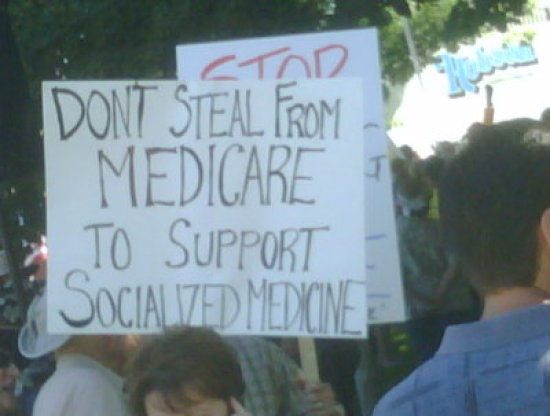
I have strong opinions about health care reform, but I couldn't pass this commentary up.
from the Huffington Post
I have strong opinions about health care reform, but I couldn't pass this commentary up.
Thursday, June 18, 2009
Anxiety!
My anxiety levels have been through the roof recently. And it's odd (for me) because nothing has really changed.
Things are going well and have been pretty stable for some time now.
I hesitate to even mention this, as it's over-sharing no doubt, but I also try to be pretty honest about my journey and where I'm at.
And, if there is one person reading this blog who has ever been remotely near this place (where I am), and thinks twice about getting help because they think "well, aerin did it, so maybe I can too" - that's why I'm bringing this up.
So a person doesn't feel like they are the only person on earth who has ever felt this way. Where I physically feel a tightness in my chest - it's hard to breathe.
Deep breathing/meditation doesn't seem to help. Haven't broken out the "Anxiety and Phobia Workbook" yet, but that's helped in the past.

I'm going to make an appointment and get it checked out. Who knows where the journey will lead.
I'm so thankful that the stigma on this type of thing is disappearing.
It is still there. And it's not covered by some health insurance (another complaint I have)....
Sometimes I still even hear people say something like "you have to be really crazy to..." but honestly, I feel it's a little like alcoholism and addiction. Sure, there are a ton of people out there who are severe alcoholics/addict, the wild off the wall non functioning type who are homeless, family -less or worse because they can't stop drinking - the 10% or so. Then there are the rest who may have a problem, but they keep up with their job, their families, some of their responsibilities. In other words, functioning alcoholics.
Yeah, I know that functioning line is hard to draw.
What I'm saying is, I don't have to have lost everything in my life to realize I need help.
Someone wise I read recently mentioned that in our culture/society - we know so many buzzwords for self-help and therapy that we don't think we really need to work on things - with a professional. The idea of opening up can be terrifying.
I grew up in a family where the stigma was incredibly real. As I've mentioned before, my own mom went years before being officially treated and diagnosed. I remember hearing that shrinks weren't interested in helping anyone, just keeping people in therapy. I heard that if we all just prayed more, and read the scriptures we would be okay.
And I can't help but think sometimes about all that wasted time. If we hadn't been fighting that stigma as a family.
Ignoring the problem didn't work for us then and it will definitely NOT work for me now.
So I'm going to continue to breathe. Wish me luck.
Things are going well and have been pretty stable for some time now.
I hesitate to even mention this, as it's over-sharing no doubt, but I also try to be pretty honest about my journey and where I'm at.
And, if there is one person reading this blog who has ever been remotely near this place (where I am), and thinks twice about getting help because they think "well, aerin did it, so maybe I can too" - that's why I'm bringing this up.
So a person doesn't feel like they are the only person on earth who has ever felt this way. Where I physically feel a tightness in my chest - it's hard to breathe.
Deep breathing/meditation doesn't seem to help. Haven't broken out the "Anxiety and Phobia Workbook" yet, but that's helped in the past.
I'm going to make an appointment and get it checked out. Who knows where the journey will lead.
I'm so thankful that the stigma on this type of thing is disappearing.
It is still there. And it's not covered by some health insurance (another complaint I have)....
Sometimes I still even hear people say something like "you have to be really crazy to..." but honestly, I feel it's a little like alcoholism and addiction. Sure, there are a ton of people out there who are severe alcoholics/addict, the wild off the wall non functioning type who are homeless, family -less or worse because they can't stop drinking - the 10% or so. Then there are the rest who may have a problem, but they keep up with their job, their families, some of their responsibilities. In other words, functioning alcoholics.
Yeah, I know that functioning line is hard to draw.
What I'm saying is, I don't have to have lost everything in my life to realize I need help.
Someone wise I read recently mentioned that in our culture/society - we know so many buzzwords for self-help and therapy that we don't think we really need to work on things - with a professional. The idea of opening up can be terrifying.
I grew up in a family where the stigma was incredibly real. As I've mentioned before, my own mom went years before being officially treated and diagnosed. I remember hearing that shrinks weren't interested in helping anyone, just keeping people in therapy. I heard that if we all just prayed more, and read the scriptures we would be okay.
And I can't help but think sometimes about all that wasted time. If we hadn't been fighting that stigma as a family.
Ignoring the problem didn't work for us then and it will definitely NOT work for me now.
So I'm going to continue to breathe. Wish me luck.
Tuesday, June 2, 2009
My pick? The next bubble: Medical
I'm not an economist. I don't pretend to understanding all the factors in various economies. I don't pretend to understand the current financial crisis or the internet bubble (or even the tulip bubble in the Netherlands in the 1630s).
But I will share my observation and experience. Some months ago, I went to a local newly renovated hospital for some routine tests. (I'm fine, btw).
I was taken aback by the opulence. I have been to the Hermitage (in St. Petersburg), and that palace was opulent.

(Note: this is a photo from the Hermitage museum, NOT the local hospital)
And I do believe that a person's environment and surroundings influence their attitude.
But this hospital was full of new, original works of art (paintings and sculpture). This was not the framed print from motel 8. In the lobby, full of plush new chairs, there was a grand piano. There was also a schedule for when the pianist would be performing (8 - 5, daily).
If I hadn't seen the wheelchairs, I wouldn't have realized I was in a hospital lobby.
The other thing to bring up is that in our large Midwestern town, there are at least four other major hospitals within a thirty minute radius. And they are all competing for patients (and physicians). They want to provide the best experience possible. Sometimes I feel like they are re-decorating just to re-decorate.
Because the health care business is booming.
And much like the housing crisis, I've also heard comments like "people will always get sick. They will always need access to good health care."
That statement is emphatically true.
But just as with housing, the level of care (or type of housing people will always need) changes. Clearly, housing prices have not always gone up. So will the medical field continue to grow? Exponentially?
Do I really need a hospital with a pianist in the front lobby? Do I (or my insurance) really need to pay for that? Can I live without that and still have a good experience getting medical care?
I do want to go to a doctor with the best experience and good, safe, reliable equipment.
I also believe in supporting the arts.
However, it is hard to support the arts on the backs of people going bankrupt to pay for their illnesses.
At what point does this system reach critical mass, where the field has over-extended? I can't say. And how can we balance good care and availability of care? Maybe it will never be over-extended or over-built.
I don't have a solution.
I just observe that maybe we need to re-think our priorities as a society.
But I will share my observation and experience. Some months ago, I went to a local newly renovated hospital for some routine tests. (I'm fine, btw).
I was taken aback by the opulence. I have been to the Hermitage (in St. Petersburg), and that palace was opulent.
(Note: this is a photo from the Hermitage museum, NOT the local hospital)
And I do believe that a person's environment and surroundings influence their attitude.
But this hospital was full of new, original works of art (paintings and sculpture). This was not the framed print from motel 8. In the lobby, full of plush new chairs, there was a grand piano. There was also a schedule for when the pianist would be performing (8 - 5, daily).
If I hadn't seen the wheelchairs, I wouldn't have realized I was in a hospital lobby.
The other thing to bring up is that in our large Midwestern town, there are at least four other major hospitals within a thirty minute radius. And they are all competing for patients (and physicians). They want to provide the best experience possible. Sometimes I feel like they are re-decorating just to re-decorate.
Because the health care business is booming.
And much like the housing crisis, I've also heard comments like "people will always get sick. They will always need access to good health care."
That statement is emphatically true.
But just as with housing, the level of care (or type of housing people will always need) changes. Clearly, housing prices have not always gone up. So will the medical field continue to grow? Exponentially?
Do I really need a hospital with a pianist in the front lobby? Do I (or my insurance) really need to pay for that? Can I live without that and still have a good experience getting medical care?
I do want to go to a doctor with the best experience and good, safe, reliable equipment.
I also believe in supporting the arts.
However, it is hard to support the arts on the backs of people going bankrupt to pay for their illnesses.
At what point does this system reach critical mass, where the field has over-extended? I can't say. And how can we balance good care and availability of care? Maybe it will never be over-extended or over-built.
I don't have a solution.
I just observe that maybe we need to re-think our priorities as a society.
Wednesday, March 11, 2009
Sometimes I feel just like a human being
The human body is an amazing organism.
So we incubate for ten months - and during that time develop a heart, lungs, bones and muscles. And what we have developed can last us until age 60, 80 or 110. I don't think about it very often (the concept of a heart beating for 95 years) because if I did my head would hurt.
Someone I know (my father in law) has now had a pacemaker AND a new hip put in, in the span of a year. Thankfully, not at the same time, but within a few months of one another.
Funny how we don't really think about those things (our hearts beating regularly or hip joints moving) until they stop working. It's also fairly awe-inspiring that we know enough to be able to treat these problems - so people don't have to live in pain (or as invalids) as they get older. No wonder the life expectancy isn't age fifty any longer.
So we incubate for ten months - and during that time develop a heart, lungs, bones and muscles. And what we have developed can last us until age 60, 80 or 110. I don't think about it very often (the concept of a heart beating for 95 years) because if I did my head would hurt.
Someone I know (my father in law) has now had a pacemaker AND a new hip put in, in the span of a year. Thankfully, not at the same time, but within a few months of one another.
Funny how we don't really think about those things (our hearts beating regularly or hip joints moving) until they stop working. It's also fairly awe-inspiring that we know enough to be able to treat these problems - so people don't have to live in pain (or as invalids) as they get older. No wonder the life expectancy isn't age fifty any longer.
Thursday, January 15, 2009
Dieting in January
Mornings like this morning make me wonder why people start their diets in January - and then get discouraged.
Not that I'm not fully supportive of people trying to get (and stay) healthy and lose weight. Particularly if people are like me and didn't find a cookie/brownie/cake they didn't have to try over the holiday season.
But this morning, it was cold. I'm not someone who typically complains about the weather, but I have to admit, it was chilly. And those of you in colder climates (north or near the Rockies) have been experiencing this for months now. (And it's been worse, no doubt).
So when the temperature is sub zero - it seems to me it's much more difficult to eat salad. It's much more difficult to eat smaller portions. Because if you are cold, it's that much more difficult to get over that instinctual notion that body fat protects
you and will help you be warmer. Or - more food will help keep you warm. That's been my experience any way.
Sure there are plenty of low fat/calorie things that are actually good for you. Oatmeal. Non cream based soups.
And it's even more difficult to get out and walk around the block (if there is snow or ice out). Or drive to the gym. Well, IMO, more difficult than in, say, March or April. Where I'm at - March and April arebeginning to get warmer. The snow melts. There are more greens - it's not nearly as cold.
I understand it's a new year. I understand waking up and realizing - another year has gone by and I haven't worked on this. I can understand wanting to maintain your current weight. But losing weight? A difficult proposition in Jan. if you don't live in Florida, Arizona, California or Southern France.
Now - quitting smoking this time of year - that makes more sense. Standing outside has got to be really, really cold. And - the taxes on cigarettes just went up. That is probably an easier resolution to keep.
Not that I'm not fully supportive of people trying to get (and stay) healthy and lose weight. Particularly if people are like me and didn't find a cookie/brownie/cake they didn't have to try over the holiday season.
But this morning, it was cold. I'm not someone who typically complains about the weather, but I have to admit, it was chilly. And those of you in colder climates (north or near the Rockies) have been experiencing this for months now. (And it's been worse, no doubt).
So when the temperature is sub zero - it seems to me it's much more difficult to eat salad. It's much more difficult to eat smaller portions. Because if you are cold, it's that much more difficult to get over that instinctual notion that body fat protects
you and will help you be warmer. Or - more food will help keep you warm. That's been my experience any way.
Sure there are plenty of low fat/calorie things that are actually good for you. Oatmeal. Non cream based soups.
And it's even more difficult to get out and walk around the block (if there is snow or ice out). Or drive to the gym. Well, IMO, more difficult than in, say, March or April. Where I'm at - March and April arebeginning to get warmer. The snow melts. There are more greens - it's not nearly as cold.
I understand it's a new year. I understand waking up and realizing - another year has gone by and I haven't worked on this. I can understand wanting to maintain your current weight. But losing weight? A difficult proposition in Jan. if you don't live in Florida, Arizona, California or Southern France.
Now - quitting smoking this time of year - that makes more sense. Standing outside has got to be really, really cold. And - the taxes on cigarettes just went up. That is probably an easier resolution to keep.
Wednesday, January 14, 2009
To not do for other adults what they can do for themselves
It sounds like a pretty simple concept. In fact, this is actually quite complicated. And something I've been working on. I was placed into a mother type role when I was fairly young for various reasons. There were some times when if I didn't do something, it didn't get done. I still have some anger and resentment over some of this, but I'm really working on it. I also partially mention it to explain, this happened - and it's part of why I am the way that I am.
So, from a young age, I became used to taking care of other people and picking up the slack. Sometimes there was a lot of slack. These habits are difficult to unlearn.
As one could imagine, there are an awful lot of people around who want me (or others) to take care of them, to make decisions so that they don't have to face the consequences. Or, because someone else has always done something for them, they don't
realize the coordination it takes to get done. When you read some early feminist writing, I've read about women who want(ed) a "wife" - someone who would take care of all their needs (food, laundry, etc.) so they can spend full time researching, writing or studying. So these types of cultural notions don't magically appear in a vacuum.
Of course there are people every day who give selflessly - who help adults who are not able to help themselves for reasons of mental or physical impairment. And I'm not a fan of parents who throw their child out on their ear the day after they turn eighteen. Being a mom myself, I know that I have two people who are completely dependent on me. Some of that dependence will be for the rest of my life - but what life looked like when they were three months old is vastly different than when they're in their thirties.
But it's a balance and a process - one I've spoken about here before. The more I read, study and meditate, the more I see where I have occasionally overstepped my bounds. Where I've tried to take on someone else's responsibility for their own person. Where my interference (potentially well-meaning) was not needed or welcome.
Often, I justified myself by not wanting to hear that person complain. You might think I'm kidding, but I'm not. In the past, if someone was complaining and there was something I could do about it (even if they had ended up in the situation by their own doing) it would drive me nuts. I had white knight syndrome of sorts. I'm out to save the world. And sometimes it was to save me clean up work - to save doing something at the last minute.
That's not to say that I have things I'm good at and other people have things they are good at. Figuring out dates and scheduling appointments? I'm pretty good at that. Figuring out a quick response to the salesman at the gym or a tactful way to save face - no, not so good at that. So I definitely need other people (adults) help and assistance each day.
But there is a point where I realize I need to back off and chill.
So, from a young age, I became used to taking care of other people and picking up the slack. Sometimes there was a lot of slack. These habits are difficult to unlearn.
As one could imagine, there are an awful lot of people around who want me (or others) to take care of them, to make decisions so that they don't have to face the consequences. Or, because someone else has always done something for them, they don't
realize the coordination it takes to get done. When you read some early feminist writing, I've read about women who want(ed) a "wife" - someone who would take care of all their needs (food, laundry, etc.) so they can spend full time researching, writing or studying. So these types of cultural notions don't magically appear in a vacuum.
Of course there are people every day who give selflessly - who help adults who are not able to help themselves for reasons of mental or physical impairment. And I'm not a fan of parents who throw their child out on their ear the day after they turn eighteen. Being a mom myself, I know that I have two people who are completely dependent on me. Some of that dependence will be for the rest of my life - but what life looked like when they were three months old is vastly different than when they're in their thirties.
But it's a balance and a process - one I've spoken about here before. The more I read, study and meditate, the more I see where I have occasionally overstepped my bounds. Where I've tried to take on someone else's responsibility for their own person. Where my interference (potentially well-meaning) was not needed or welcome.
Often, I justified myself by not wanting to hear that person complain. You might think I'm kidding, but I'm not. In the past, if someone was complaining and there was something I could do about it (even if they had ended up in the situation by their own doing) it would drive me nuts. I had white knight syndrome of sorts. I'm out to save the world. And sometimes it was to save me clean up work - to save doing something at the last minute.
That's not to say that I have things I'm good at and other people have things they are good at. Figuring out dates and scheduling appointments? I'm pretty good at that. Figuring out a quick response to the salesman at the gym or a tactful way to save face - no, not so good at that. So I definitely need other people (adults) help and assistance each day.
But there is a point where I realize I need to back off and chill.
Tuesday, April 29, 2008
Books I've read recently
I've actually had some time to read recently - two for book club, two on my own.
The Memory Keeper's Daughter by Kim Edwards

This book had a fascinating premise. The basic plot involves a doctor in the 60s who delivers his own twins in a snowstorm. His wife is in a drugged haze and only the doctor's closest nurse is at the delivery. When he realizes that his daughter has Down Syndrome, he decides to send her to an institution. He also lies to his wife, and tells her their daughter died. Their son survives. Disgusted by the nature of the institution, the nurse chooses to raise the daughter as her own. The book follows the lives of the families, the basis behind the father's decision and lies.
I will say, the characterizations were sometimes a bit stretched. Some of the events seemed improbable. I will admit to being a literary snob - expecting unique and full fleshed out characters with every novel. To my mind, one scene was very contrived, as if "they all woke up and it was a dream". It seemed like an obvious plot device to move the book along. I won't mention what it was, but if you read the book, it's not hard to determine.
What I did appreciate, however, was the notion of how damaging some family secrets can be. Back in the day, families kept silent about many things. Adoption, alcoholism, mental illness, mental disability, ancestry, etc. Sick as our secrets definitely applies here. And in the book, it's obvious that this secret impacted each of the main characters lives. I'd like to think that we are more open today, that we are more willing to face these issues and the supposed embarrassment they might cause.
I will say, in terms of secrets, I do think there are some things better left unsaid. Obviously, in terms of this blog, I don't often take that advice. But as a parent, and a friend, it's hard to know where that line is. But in each decision, a person has to weigh the costs and benefits. And most certainly, with the above list of adoption, mental illness, physical illnesses, death, etc. - I believe fully that a family should be as open as possible.
Which leads me to the second book I've read:
Secret Girl by Molly Bruce Jacobs

In the not so distant past, it was common to institutionalize the mentally disabled. Even today, some Americans find out that they had siblings, family members they never knew they had who had been institutionalized. This was the case for Molly Bruce Jacobs.
Her sister was institutionalized after birth. The author didn't know of her existence until she was thirteen, and didn't visit her until she was in her 30s. The memoir follows her life, as the author struggles to make sense of this impossible choice. She works to develop a relationship with her sister and understand this secret's impact on her life and her alcoholism.
It is an unbelievably sad and honest memoir. It tells how an adult understands and accepts their parents' actions and accepts and forgives their own actions and motivations. Molly wasn't defending her parents' actions, but by writing the memoir and developing a relationship with her sister - she was trying to make things right. As right as she could make them. Just like any of us, knowing we can't make up for the past, but trying to do the best we can with what we have.
On from family secrets/dysfunction:
Night Watch by Sergei Lukyanenko
wikipedia entry about the novel
This is much lighter than the other two books. It's sci-fi/fantasy - good guys vs. vampires, light vs. dark. There is definitely a tradition of Bulgakov here, I don't get all the references but I'm pretty certain they are there. Like the best sci-fi books, there isn't a clear line between good and evil. Everyone is just doing their best, what they think is the best.
While there are some great female characters in this book (like Tiger Cub and Olga), it doesn't pass the two females having a conversation on screen test. At least not in this first book. There is, of course, one scene where Anton switches bodies with Olga - and has a conversation with his love interest, but that doesn't count (to my mind). That scenario is actually very Russian - from my experiences there. Many of my American professors would say that Russian culture (at least in the mid-90s) was as if the sexual revolution never happened here. It still may be true. At least, women are required to wear makeup, care about their appearance - otherwise they might be lesbians.
Okay, perhaps that isn't fair with the novel, but there is definitely a Russian cultural tradition there. And, with all the comments about switching bodies and Anton struggling with high heels and makeup - and other restaurant goers saying that Anton looked butch - it's not a stretch to my mind. I may be mistaken - but that was my impression. The women in the novel (and movies) do have a central role, but it was some of those stereotypes that really bothered me.
So aside from American cultural issues, it was a fascinating insight into current Russian culture (despite being about vampires). The reader knows that Anton's side, the light, is fighting a losing battle, but you can't help but root for them.
Last but not least is:
The Painted Drum by Louise Erdrich

I've always like Louise Erdrich's work. She has an amazing grasp on language. She also has stunning insight into humans and their relationships. This was one of the books we discussed at book club, and one of the participants praised the use of native american culture and lore. It is, sadly, a perspective and story that is not often told. Just as with the first two books, some parts were particularly sad. One or two of the characters/sub plots did seem out of place, but all in all, an interesting read.
The issues she discusses of repatriation are incredibly important and relevant. It is difficult to decide which community an object belongs to, particularly a sacred object. In the novel, the drum has an intensely spiritual connection - and it restores community (either magically or coincidentally, depending on your perspective).
I think the nature of spiritual objects, respect, scientific study is one I will save for another blog post. But I believe these issues are very important. For many of these native cultures, their objects and culture were stolen. And genocide was committed against some of the native american communities by the United States government. There's no other way to view the small pox laced blankets or the trail of tears.
I found this article on the Smithsonian website when I was researching this topic. The author clearly understands how controversial this topic can be. From what she writes, I can also see the museum and learning perspective. That there may be some history that can be gleaned from specific objects and processes. But only when all parties agree to allow the research and respect is the foundation of the research.
The Memory Keeper's Daughter by Kim Edwards
This book had a fascinating premise. The basic plot involves a doctor in the 60s who delivers his own twins in a snowstorm. His wife is in a drugged haze and only the doctor's closest nurse is at the delivery. When he realizes that his daughter has Down Syndrome, he decides to send her to an institution. He also lies to his wife, and tells her their daughter died. Their son survives. Disgusted by the nature of the institution, the nurse chooses to raise the daughter as her own. The book follows the lives of the families, the basis behind the father's decision and lies.
I will say, the characterizations were sometimes a bit stretched. Some of the events seemed improbable. I will admit to being a literary snob - expecting unique and full fleshed out characters with every novel. To my mind, one scene was very contrived, as if "they all woke up and it was a dream". It seemed like an obvious plot device to move the book along. I won't mention what it was, but if you read the book, it's not hard to determine.
What I did appreciate, however, was the notion of how damaging some family secrets can be. Back in the day, families kept silent about many things. Adoption, alcoholism, mental illness, mental disability, ancestry, etc. Sick as our secrets definitely applies here. And in the book, it's obvious that this secret impacted each of the main characters lives. I'd like to think that we are more open today, that we are more willing to face these issues and the supposed embarrassment they might cause.
I will say, in terms of secrets, I do think there are some things better left unsaid. Obviously, in terms of this blog, I don't often take that advice. But as a parent, and a friend, it's hard to know where that line is. But in each decision, a person has to weigh the costs and benefits. And most certainly, with the above list of adoption, mental illness, physical illnesses, death, etc. - I believe fully that a family should be as open as possible.
Which leads me to the second book I've read:
Secret Girl by Molly Bruce Jacobs
In the not so distant past, it was common to institutionalize the mentally disabled. Even today, some Americans find out that they had siblings, family members they never knew they had who had been institutionalized. This was the case for Molly Bruce Jacobs.
Her sister was institutionalized after birth. The author didn't know of her existence until she was thirteen, and didn't visit her until she was in her 30s. The memoir follows her life, as the author struggles to make sense of this impossible choice. She works to develop a relationship with her sister and understand this secret's impact on her life and her alcoholism.
It is an unbelievably sad and honest memoir. It tells how an adult understands and accepts their parents' actions and accepts and forgives their own actions and motivations. Molly wasn't defending her parents' actions, but by writing the memoir and developing a relationship with her sister - she was trying to make things right. As right as she could make them. Just like any of us, knowing we can't make up for the past, but trying to do the best we can with what we have.
On from family secrets/dysfunction:
Night Watch by Sergei Lukyanenko
wikipedia entry about the novel
This is much lighter than the other two books. It's sci-fi/fantasy - good guys vs. vampires, light vs. dark. There is definitely a tradition of Bulgakov here, I don't get all the references but I'm pretty certain they are there. Like the best sci-fi books, there isn't a clear line between good and evil. Everyone is just doing their best, what they think is the best.
While there are some great female characters in this book (like Tiger Cub and Olga), it doesn't pass the two females having a conversation on screen test. At least not in this first book. There is, of course, one scene where Anton switches bodies with Olga - and has a conversation with his love interest, but that doesn't count (to my mind). That scenario is actually very Russian - from my experiences there. Many of my American professors would say that Russian culture (at least in the mid-90s) was as if the sexual revolution never happened here. It still may be true. At least, women are required to wear makeup, care about their appearance - otherwise they might be lesbians.
Okay, perhaps that isn't fair with the novel, but there is definitely a Russian cultural tradition there. And, with all the comments about switching bodies and Anton struggling with high heels and makeup - and other restaurant goers saying that Anton looked butch - it's not a stretch to my mind. I may be mistaken - but that was my impression. The women in the novel (and movies) do have a central role, but it was some of those stereotypes that really bothered me.
So aside from American cultural issues, it was a fascinating insight into current Russian culture (despite being about vampires). The reader knows that Anton's side, the light, is fighting a losing battle, but you can't help but root for them.
Last but not least is:
The Painted Drum by Louise Erdrich
I've always like Louise Erdrich's work. She has an amazing grasp on language. She also has stunning insight into humans and their relationships. This was one of the books we discussed at book club, and one of the participants praised the use of native american culture and lore. It is, sadly, a perspective and story that is not often told. Just as with the first two books, some parts were particularly sad. One or two of the characters/sub plots did seem out of place, but all in all, an interesting read.
The issues she discusses of repatriation are incredibly important and relevant. It is difficult to decide which community an object belongs to, particularly a sacred object. In the novel, the drum has an intensely spiritual connection - and it restores community (either magically or coincidentally, depending on your perspective).
I think the nature of spiritual objects, respect, scientific study is one I will save for another blog post. But I believe these issues are very important. For many of these native cultures, their objects and culture were stolen. And genocide was committed against some of the native american communities by the United States government. There's no other way to view the small pox laced blankets or the trail of tears.
I found this article on the Smithsonian website when I was researching this topic. The author clearly understands how controversial this topic can be. From what she writes, I can also see the museum and learning perspective. That there may be some history that can be gleaned from specific objects and processes. But only when all parties agree to allow the research and respect is the foundation of the research.
Friday, June 1, 2007
Privacy with Friends
Someone suggested the other night that in my group of friends, we really don't have any boundaries set.
At least in terms of medical tests/diagnoses.
To give an example, my husband told a mutual friend that we were expecting - about 6-8 weeks before I wanted to tell anyone. I think that was after he found out we were having twins. I just knew all the risks. Someone said they felt I was being morbid for not wanting to tell anyone. But the statistics show that 1 out of 5 pregnancies end in miscarriage before eight weeks. And with twins, there are lots of risks, including the vanishing twin syndrome.
The friend my husband told worriedly confided in another mutual friend, who was offended that I hadn't told her first. hadn't told any friends at that point. I hadn't told anyone I worked with - especially since my pregnancy would impact everyone on my team at work (since I would probably take maternity leave, be gone for three months and they would have to pick up the slack). But it was still a messy situation.
On the other hand, I don't think it's reasonable to never talk about medical stuff with your friends.
There are a lot of good reasons to talk.
I am pretty open about being tested for cholesterol, and my high cholesterol diagnosis when I was in my late 20s. The way I see it, I would rather talk about it so that other people could get their cholesterol checked. Yes, the research on cholesterol is mixed, and high cholesterol by itself doesn't mean heart disease, but I would rather find out now and make changes in my diet/lifestyle sooner than later.
I heard of another good example of this on npr a few weeks ago. A young woman (featured in the "Nordie's at Noon" book) had started doing her monthly breast exams because of her friend's diagnosis. She found a lump and credits the fact that she's here today to her friend.
So, in a group of friends, it's nice to know about some things - to be supportive. I would hate to think of my good friends going through breast cancer, diabetes, heart disease, etc. alone.
On the other hand, there are some things that are really no one else's business. It's hard to know though. Whether or not someone is going to therapy, for example. Whether or not someone is taking medication for depression. Sometimes, this kind of information can be helpful, and might encourage a friend to seek treatment where they hadn't before.
On the other hand, there is still a stigma attached to going to therapy and taking medication (see my related post here). I wish I could say that most of our friends didn't judge people on medical conditions,but unfortunately there is some judgement there. One person still reacts whenever I talk about my cholesterol that I shouldn't have been tested, shouldn't worry about it because I'm too young.
And while some of our friends don't care, I think there are some that do. It's just a fine line. And it gets even more complicated if job/hiring/firing type decisions come into play. Who knows whether or not one could experience discrimination about a potential job if they know that a potential candidate has gone to outpatient/inpatient therapy and have taken or are taking anti-depressants? Whether or not this attitude is right, doesn't mean that it doesn't exist and doesn't happen.
Just wanted to find out if anyone has set these types of boundaries with friends and how you might handle these types of things.
Mormons (and my family in particular) famously have little to no boundaries about anything, so learning more about what to share and what not to share could be a good thing.
At least in terms of medical tests/diagnoses.
To give an example, my husband told a mutual friend that we were expecting - about 6-8 weeks before I wanted to tell anyone. I think that was after he found out we were having twins. I just knew all the risks. Someone said they felt I was being morbid for not wanting to tell anyone. But the statistics show that 1 out of 5 pregnancies end in miscarriage before eight weeks. And with twins, there are lots of risks, including the vanishing twin syndrome.
The friend my husband told worriedly confided in another mutual friend, who was offended that I hadn't told her first. hadn't told any friends at that point. I hadn't told anyone I worked with - especially since my pregnancy would impact everyone on my team at work (since I would probably take maternity leave, be gone for three months and they would have to pick up the slack). But it was still a messy situation.
On the other hand, I don't think it's reasonable to never talk about medical stuff with your friends.
There are a lot of good reasons to talk.
I am pretty open about being tested for cholesterol, and my high cholesterol diagnosis when I was in my late 20s. The way I see it, I would rather talk about it so that other people could get their cholesterol checked. Yes, the research on cholesterol is mixed, and high cholesterol by itself doesn't mean heart disease, but I would rather find out now and make changes in my diet/lifestyle sooner than later.
I heard of another good example of this on npr a few weeks ago. A young woman (featured in the "Nordie's at Noon" book) had started doing her monthly breast exams because of her friend's diagnosis. She found a lump and credits the fact that she's here today to her friend.
So, in a group of friends, it's nice to know about some things - to be supportive. I would hate to think of my good friends going through breast cancer, diabetes, heart disease, etc. alone.
On the other hand, there are some things that are really no one else's business. It's hard to know though. Whether or not someone is going to therapy, for example. Whether or not someone is taking medication for depression. Sometimes, this kind of information can be helpful, and might encourage a friend to seek treatment where they hadn't before.
On the other hand, there is still a stigma attached to going to therapy and taking medication (see my related post here). I wish I could say that most of our friends didn't judge people on medical conditions,but unfortunately there is some judgement there. One person still reacts whenever I talk about my cholesterol that I shouldn't have been tested, shouldn't worry about it because I'm too young.
And while some of our friends don't care, I think there are some that do. It's just a fine line. And it gets even more complicated if job/hiring/firing type decisions come into play. Who knows whether or not one could experience discrimination about a potential job if they know that a potential candidate has gone to outpatient/inpatient therapy and have taken or are taking anti-depressants? Whether or not this attitude is right, doesn't mean that it doesn't exist and doesn't happen.
Just wanted to find out if anyone has set these types of boundaries with friends and how you might handle these types of things.
Mormons (and my family in particular) famously have little to no boundaries about anything, so learning more about what to share and what not to share could be a good thing.
Subscribe to:
Posts (Atom)